As I previously wrote, QUAFF is an award-winning homebrew club that aims to foster both great homebrewers and great beer judges. We have six club-only competitions per year plus host the America’s Finest City competition, an American Homebrewers Association sanctioned competition.
In order to develop judges’ skills, QUAFF hosts Beer Judge Certification Program training courses to prepare judges for the beer, mead, and cider tasting exams as well as the BJCP written exam. As a result of this sensory training, QUAFF generates an overabundance of qualified judges. Many of the judges are also award-winning homebrewers and go on to become professional brewers (who also win awards).
There are over 78,000 active BJCP-ranked judges in the world according to the recently updated BJCP demographics. Each month the BJCP database gets updated and milestones are celebrated when folks earn new ranks. Oleg Shpyrko, BJCP Master judge and the head of Team QUAFF and continuing education, shared this really useful flowchart of the BJCP process created by Dennis Mitchell, Grand Master II judge.
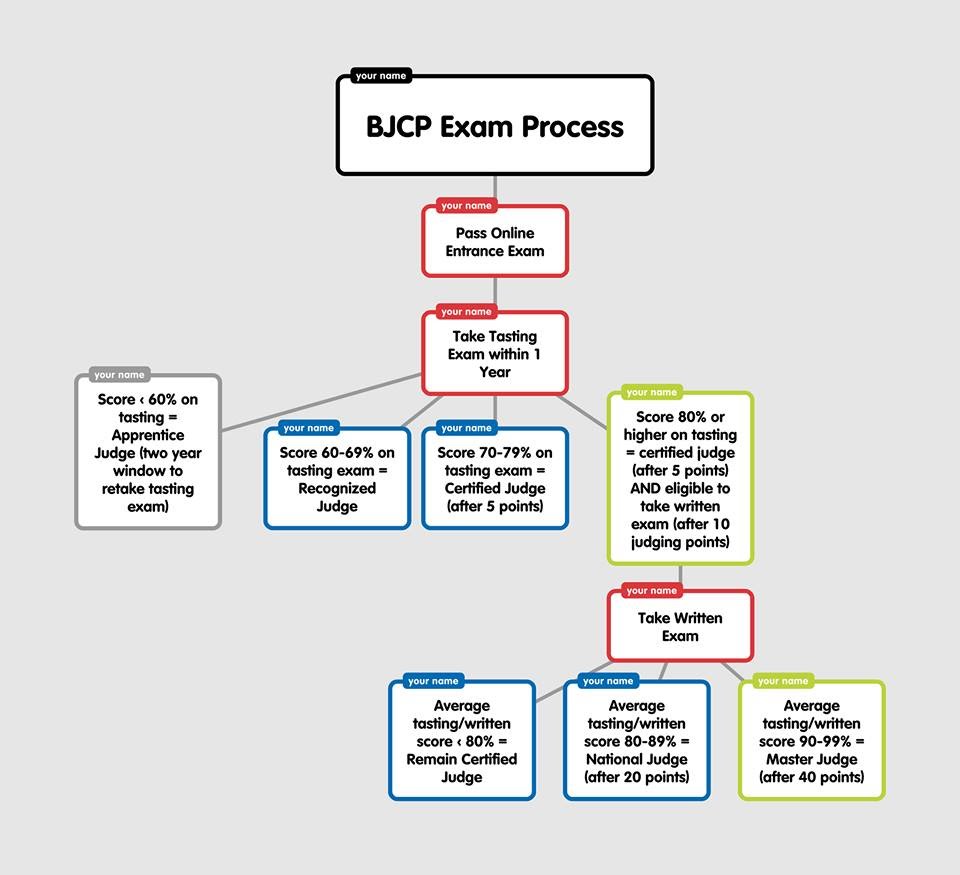
For BJCP Beer Judges the ranks are: Apprentice, Recognized, Certified, National, and Master. Once someone is a Master judge they can earn further ranks by administering or grading exams, serving on BJCP committees, and otherwise growing the BCJP organization.
As you can see, obtaining the National or Master beer judge rank is worth celebrating. While QUAFF cannot claim to be the only cause, San Diego County is overwhelmingly represented within the BJCP ranks.
The 9 active judges in San Diego County account for 7.2% of all active Master or higher judges worldwide (125). That’s higher than any other county in California, any other state in the US, and any other country.
Similarly, the 28 active National judges in San Diego County are 3.66% of all active National judges worldwide (766). That’s higher than any other county in California, higher than 42 other states (only OH, TX, FL, IL, NY, MN, and CO having between 29-35 each), and higher than every other country except Canada (has 33 National judges across a population of 38mil).
Also, the 16 active Mead judges in San Diego County are 2.92% of all active Mead judges worldwide (548). That’s higher than any other county in California other than Sacramento (17) and Los Angeles (19), equal to or higher than 42 other states (only PA, FL, MI, CO, NY, MN, and TX having between 19-37 each), and equal to or higher than every other country except Canada (has 28 Mead judges).
Finally, the 8 active Cider judges in San Diego County are 8.51% of all active Cider judges worldwide (94). That’s higher than any other county in California, any other state in the US, and any other country.
The mead and cider designations are more streamlined than the beer ranks. They also have an online entrance exam but only have a tasting exam. If someone is already a BJCP member and scores ≥60% on the tasting exam then they earn a mead/cider endorsement. If they are not a BJCP beer member, then their rank is a mead/cider judge. While mead and cider categories have long been included in the the BJCP Style Guidelines, the rankings have been slowly developed in response to the need for qualified judges at competitions. The slower growth is in part due to the lack of certified trainers and exam providers for the two categories, so there are fewer exams each year. But more folks are passing each year!
I’ve attached the three scoresheets used in many judging settings. The tasting exam scoresheets have the Descriptor Definitions blanked out, so you have to know what they are, and it provides more room to write more.
The BJCP Beer Tasting Exam includes six beers over a 90 minute period. The beer style is announced along with a two-ounce sample a beer every 15 minutes. The beer sample can be homebrew or professional, old or fresh, a blend of two beers, and/or can be doctored with an off-flavor. The beer sample could also not be the stated beer style. Ideally you pace yourself to fill the scoresheets completely and have time to check everything, but in reality it feels like a race against the clock. That twelve ounces of beers of varying styles, strength, and quality, coupled with the intense focus and cramping hands, makes for an exhausting exam. Two to three proctors who are National or higher-ranked judges grade blindly along with the examinees. The exam graders compare the proctors’ sheets with the examinee’s sheets to assign the grade on the following categories, each weighed to 20% of the total score.
| Section | Description |
| Perceptive Accuracy | Perceptive Accuracy is evaluated based on the descriptions provided by the proctors and the other examinees as well as the background information on the beers provided by the exam administrator. A few dedicated training sessions with experienced judges will enable you to calibrate your palate and may improve your ability to detect secondary or more subtle characteristics. |
| Descriptive Ability | Scoresheets should use descriptive language for the perceived characteristics, including the type and intensities of the ingredients, esters, phenols and fermentation characteristics. |
| Feedback | Feedback includes comparing perceptions to the style guidelines, pointing out deviations and/or technical flaws, and suggesting specific ways to improve the recipe and/or brewing process. |
| Completeness | A complete scoresheet provides a detailed sensory evaluation rather than just hitting the highlights. It is sometimes helpful to use the list of items under each section title as an informal checklist of attributes that need to be addressed on the scoresheet, and comments should specifically note anything that was out of place or missing for the presented style. |
| Scoring Accuracy | Scores are compared to consensus score from the proctors, which are cross-checked with the average scores of all the examinees and exam beer notes from the administrator to ensure fairness. |
Here is my second tasting exam scoresheet. which went better than the first and the score of 81 will allow me to sit for the BJCP Written Exam in February 2022. I took a third exam in March 2021 the day after getting the COVID vaccine… I don’t recommend that, and the score reflected it.
Here is the Report to Participate for my second exam. It shows that there are areas I missed and need to improve. For me, the feedback is the hardest part as it either sounds like a generic response or has too much guesswork to it. “If you used dry-hopped, consider…” or “possible source of off-flavor is XYZ, consider…” I need to brew some more beer and read more to get a better sense of how to resolve brewing issues. The feedback is much simpler when there’s an obvious issue such as light-struck, and yet I missed that on the first beer sample. These exam are exhausting yet very useful building up your sensory training and becoming a better judge and brewer.
Sensory training is about building a map of aromas, flavors, visuals, and mouthfeel that add up to a particular beer style. And there are 127 beer styles, 13 mead styles, and 11 cider styles to learn. Once you can build that map in your head you have to be able to quickly yet clearly communicate it. In both competition and exam settings the goal is to give useful, positive feedback to the entrant, noting how their entry compared to the stated style. You must be able to also note any faults in the entry, their potential causes, and suggestions for improving the entry. Here are the sensory areas and key descriptors covered by the BJCP for all beer, mead, and cider.
| Sensory Area | Beer | Mead | Cider |
| Aroma | *Malt *Hops *Esters *Other Aromatics | *Honey expression *alcohol *Esters *Complexity *Other Aromatics | *Expression Of Other Ingredients |
| Appearance | *Color *Clarity *Head Retention * Head Color *Head Texture **Can also include Lacing and Legs | *Color *Legs *Carbonation | *Color *Clarity *Carbonation Level |
| Flavor | *Malt *Hops *Fermentation Characteristics *Balance *Finish/Aftertaste *Other Flavor Characteristics | *Honey *Sweetness *Acidity *tannin *Alcohol *Balance *Body *Carbonation *Aftertaste *Any Special Ingredients *Style-Specific Flavors | *Balance of Acidity. Sweetness, Alcohol Strength, Body, Carbonation *Other Ingredients *Aftertaste |
| Mouthfeel | *Body *Carbonation *Warmth *Creaminess *Astringency *Other Palate Sensations | (incorporated into other sensory categories) | (incorporated into other sensory categories) |
| Overall Impression | *Overall drinking pleasure associated with entry, give suggestions for improvement | *Overall drinking pleasure associated with entry, give suggestions for improvement | *Overall drinking pleasure associated with entry, give suggestions for improvement |
A key component to is to include both the intensity and qualifier, (e,.g., not just “fruity aroma”, but “medium-high sweet orange peel”). Another component to consider is time. Many aromas and flavors present themselves at different temperatures. So you can include “initial large sulfur quickly fades” or “initial low dark fruit (dates)[…] medium dates as warms up.” It’s rarely easy but always fun. It’s just beer, right?
It helps to keep in mind that judging, and learning to judge, is about building up your own sensory abilities and the ability to clearly communicate them. Also, it is useful to keep in mind why people enter food and drinks competitions: for process improvement (constructive feedback), for accolades (medals), and for marketing (whether amateurs wanting to transition to professionals, or pros to use for actual marketing). Quality competitions need quality judges. And quality judges need to continue learning.
With that said, I have a busy upcoming season of learning. I’m still co-coordinating the QUAFF Club-Only Competitions while continually studying (not necessarily drinking) because, over the next four months, I am scheduled for:
- BJCP Beer Tasting Exam
- BJCP Mead Tasting Exam
- Advanced Cicerone® Tasting Exam
- BJCP Written Exam
- Advanced Cicerone® Written Exam (if timing works out)
While it’s awesome to use amazing resources like Em Sauter’s Pints and Panels and Chris Leguizamon’s Virtual Beer Book Club (check them both out!), it’s best to get together with a group of people, put your head down, and study together. Everyone’s sensory equipment is different so we perceive things differently at different rates and different times. When you’re in a training session, like George Thornton’s upcoming Off-Flavor Training at Home Brewing Co, you’re able to hear how others describe what you’re experiencing, which helps build that sensory map. Keep building that map and you’ll continue to discover new areas of beer, mead, cider, alcohol, and food that you’ve never experienced before!

 Mural Brewing
Leave a reply to Terry Walls Cancel reply