I have a hard time recognizing acetaldehyde without someone pointing it out. I can tell something is off in the beer but it just feels flabby. Until just this moment I hadn’t realized flabby is a legit wine-world descriptor for acetaldehyde. In beer we look for aromas and flavors of green apple, cut grass, pumpkin guts, latex, plastic, or (my favorite) apple Jolly Rancher wrappers sans candy. Once someone says “I taste x” I completely smell it. But there’s no talking in an off-favor testing situation. So I have to find other ways of recognizing what I cannot immediately sense.
I have the Certified Cicerone exam tasting portion retake on Monday. One year ago I passed the written portion and the video demonstration with the help of all the Cicerone study materials, the Beer Judge Certification Program Style Guidelines, Randy Mosher’s Tasting Beer, and Chris Cohen‘s The Beer Scholar. Nicole Erny was a great exam facilitator who explained everything clearly.
A year prior I attended a Cicerone off-flavor training led by Sayre Piotrkowski with assistance from Pat Fahey at Santa Clara Valley Brewing. While I was the only non-brewery or retail employee in the training, it was very effective in explaining the aromas/tastes/mouthfeel/flavors that I had been reading about for so long. I think if I took a second training just before my exam I would have readily passed.
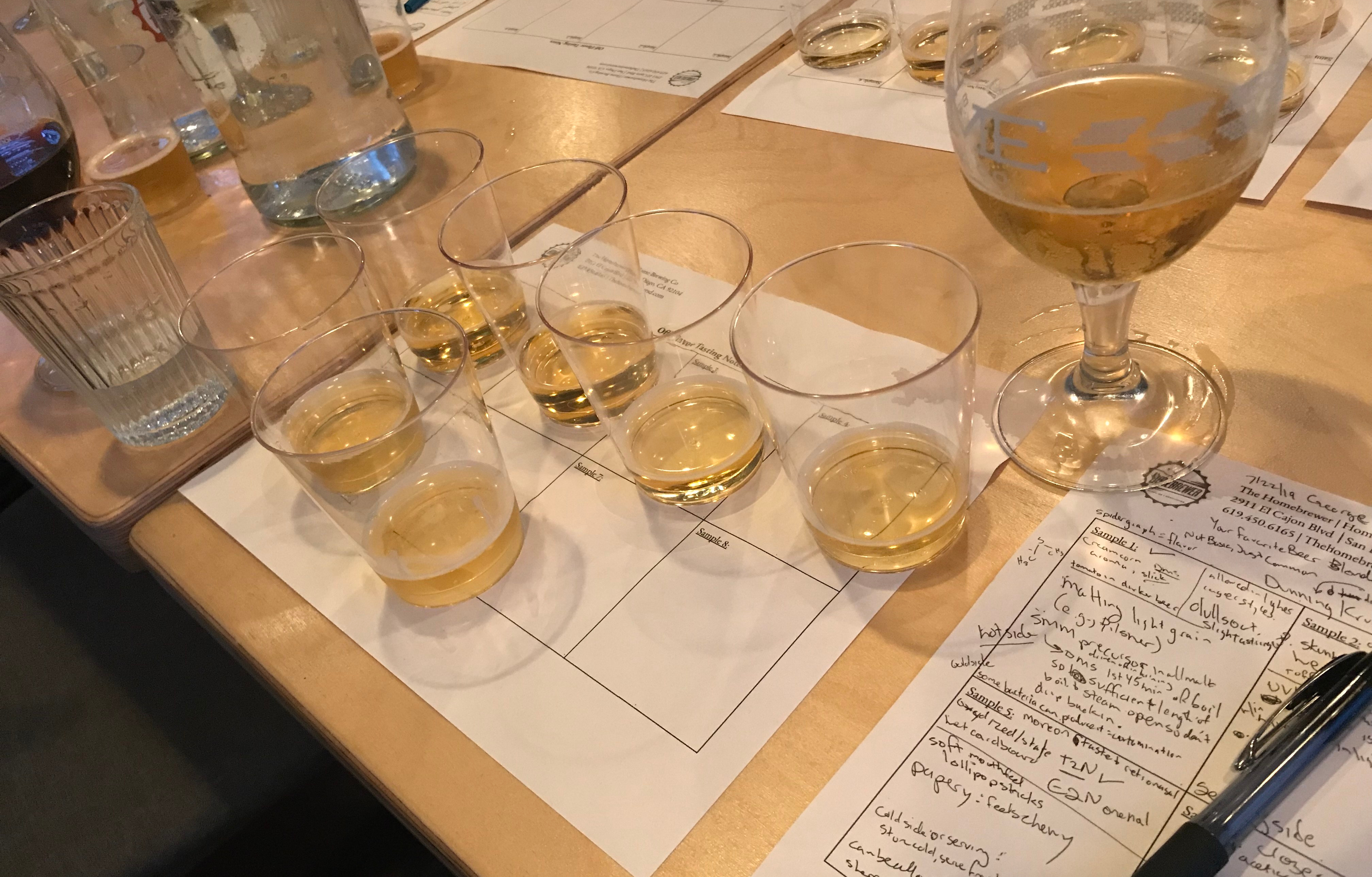
So that’s exactly what I just did. On Monday, one week before my tasting retake, I attended another off-flavor training at The Homebrewer slash Home Brewing Company led by owner George Thornton. George did a great job of guiding us through the six common off flavors using his Your Favorite Beer blonde ale as the base beer. He used the Cicerone/Aroxa Off-Flavor Kit which includes:
- Acetaldehyde (green apple, cut grass, pumpkin guts, plastic, latex)
- Diacetyl (movie theater popcorn butter, butterscotch)
- Dimethyl Sulfide (cream corn, cooked corn, tomato)
- Lightstruck (skunky, weed, green coffee)
- Trans-2-Nonenal (oxydation, stale, paper, wet cardboard)
- Contamination (combination of acetic acid (vinegar) and diacetyl)
While these flavors are unwelcome in most beers, they can be have trace amounts in certain styles based on brewery practice, ingredient choice, or heritage. Developing the ability to blindly identify what it is you’re tasting, to recall potential causes of the off flavor, and to recall if it fits within the beer style is very difficult. As Randy Mosher says in Tasting Beer (p.67),
“As we learn aromas in various contexts and concentrations, we swap out the training wheel vocabulary words for more sophisticated and richer internal tagging. This means no amount of rote learning of words and chemical formulas can turn one into an experienced taster. A book like this can help lay the framework, but ultimately we are all on our own to make the effort to build an internal map of the aromatic wonderland that is beer, aroma by frustrating aroma.”
One of my goals of studying for the Certified Cicerone, BJCP, and the like is to develop my internal map of aromas, tastes, mouthfeel, and flavors. With George and the other participants help on Monday I have a better sense of how I am blind to acetaldehyde. I like green apple flavored candy while my wife hates it. So when I come across the off flavor in small concentrations I don’t think “green apple, yuck!” In testing conditions that flabbiness or listless mouthfeel told me that something was off with the beer sample but I did not get expected aroma. But now, with practice and patience, I can identify the mouthfeel and sense of wrongness as probably acetaldehyde, note it, move on to another sample, and come back to it later. Because as the sample warmed up I did get the aroma eventually. It took patience.
Cicerone just updated their syllabi which will go into effect September 1, 2019. So my tasting exam retake on Monday still consists of three sections. The first section is identifying off flavors in four samples as compared to a control or unspiked sample. One of the four samples is unspiked. This portion of the test is focused on brewery production-created off flavors. The third portion of the test is four samples of beer where I am given the style of beer and asked whether it is okay to serve, and if not, why not. This is focused on off flavors often caused by packaging, handling, and service of the beer. So while all six off flavors will be present, some will be in the first section and not the third. The new test beginning September 1 differentiates the sections much clearer.
These are the sections I got flustered, flummoxed, and failed in the first test. the second section of the tasting portion is style comparison. You receive four samples and are asked to identify if sample 1 is A or B, sample 2 is C or D, and so on. I got four for four on this section last time, and I have reviewed styles enough that I am confident I will do well again. Some of the differences can be tricky.
After the tests are turned in at the end of the tasting portion of the Certified Cicerone exam, the proctor and test takers taste through each of the 12 samples and verbally talk it through. Cicerone is all about further education. Nicole emphasized that it would drive us nuts if we tried to grade ourselves since we had just taken a 2+ hour written test and a 45 minute tasting test. It was disheartening realizing how off I was with the off-flavor portions, but interesting to hear the breadth and depth of answers from fellow test takers. It was heartening to hear brewers’ frustration with some of the off flavors and even some of the style differentiations.
Cicerone asks participants not to disclose specifics of the test, so I won’t go into what styles I sampled or specific questions that I had. I’m looking forward to Monday’s retake. Hopefully I prepared enough so I don’t need an additional retake. I will update next week. Regardless, I will continue exploring, learning, and developing that internal map.
 Mural Brewing
Leave a comment