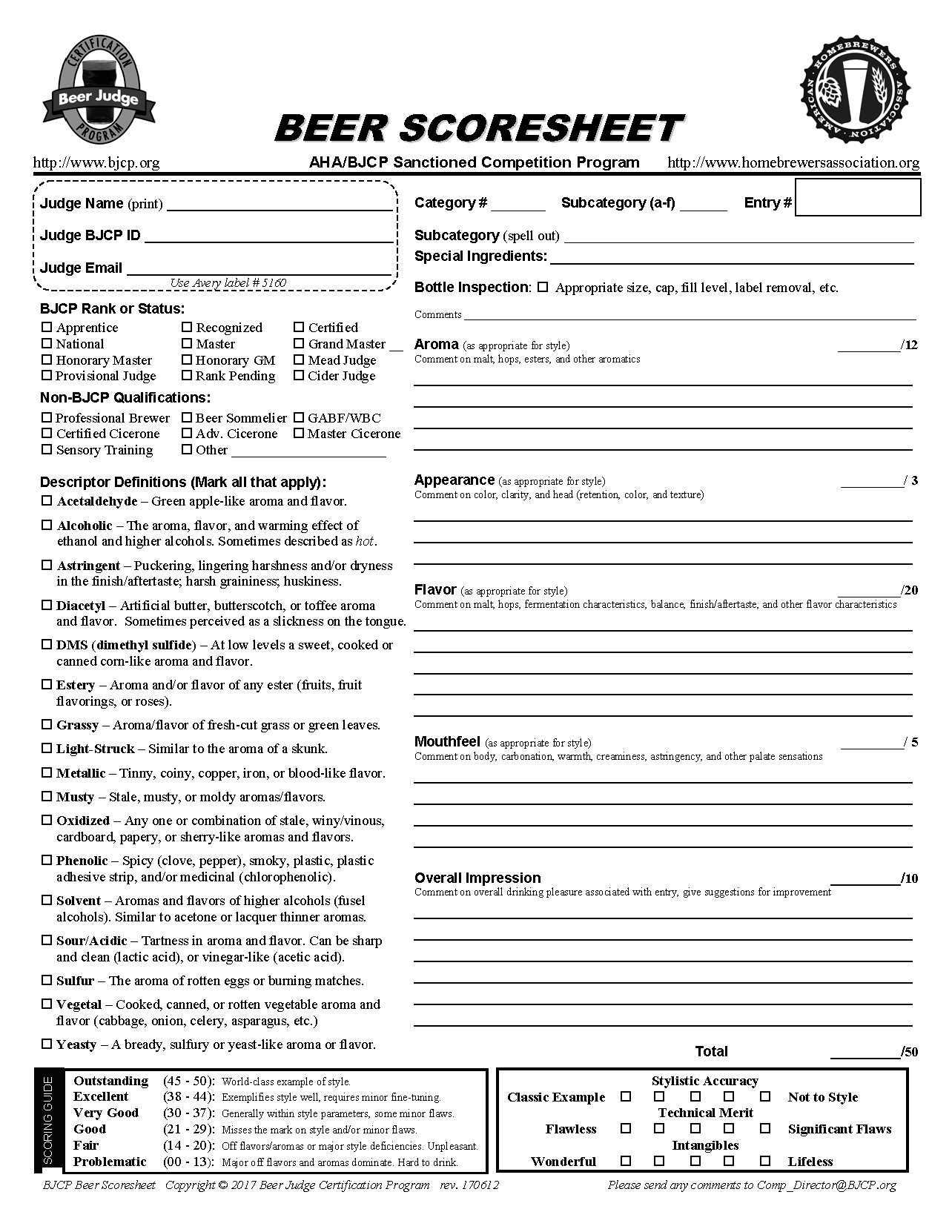
Beer judging is no easy task.
Silently staring at several ounces of cerveza in a see-through Solo cup, sniffing and swirling before sipping, savoring, swallowing and seizing sensations of mouthfeel, aroma, and flavor while strenuously scribbling subjective tasting notes to the brewer before subscribing objective scores against a studied style guide all while being surrounded by other serious judges and spry stewards.
Next the healthy debate with your partner judge, nitpicking your every decision, second-guessing your senses, spotting new things in the beer, and finally reaching a consensus on a score. Then do it all over again five to seven more times for the same beer style within a flight, with some saltines and water in between before moving on to another flight of a different style. Sometimes drinking and thinking can be exhausting.
Sometimes it’s difficult to find nice things to say about a beer, if it has noticeable flaws or just seems lifeless. Sometimes it can be “meh,” “okay,” or “pretty good.” Other times it may be a great beer but submitted in the wrong category (which can be heartbreaking as a judge, let alone the brewer). When I judged homebrew in 2014 the competition organizer told me a that a homebrewer admitted to submitting the same beer to six different categories just to get differing feedback. The reasons brewers submit their beer to competitions vary but generally it is to get feedback from experienced judges, to earn medals and accolades, and to see how they stack up against the competition.
The 2019 California State Fair Commercial Beer Competition winners were announced on Monday. This competition is only open to California commercial brewers. 132 styles were served across 62 tables, with 90 styles winning 180 awards. For example, in the Historical Beer catch-all category, an Adambier took 1st and two Kentucky Commons took 2nd and 3rd, while no Grodziskie or Lichtenhainer were submitted. We know this because there were only three entries for the category, so it was a runoff of sorts.
Compare that to the perennial number-one category of American-Style IPA with 106 entries and the newest style New England-Style IPA (Hazy IPA) with 93 entries. Out of the 1209 total entries, these two make up 9% and 8% respectively. The most entered styles were American Pale Ale (55 entries), Imperial IPA (51 entries), American-Style Fruit Beer (44 entries), and American/International Pilsner (38 entries). The medals in the pilsner category went to two German-style Pilsners and one European-style Pilsner while no Pre-Prohibition Pilsner received medals. This category was separate from Bohemian-Style Pilsner (16 entries) that included two styles: Czech Dark Lager and Czech Pale Lager, the latter which won all three medals. Confused yet? This is why competition organizers are always pulling their hair out.
While the Fair did not provide information on all breweries who participated, 101 breweries from across the state won the 180 medals.
| Grand Total | 59 | 60 | 60 | 1 | 180 | 101 | 1.78 |
| County | 1st | 2nd | 3rd | HM | Medal Total | # of Breweries | Medal Ave. |
| Los Angeles | 10 | 13 | 18 | 41 | 18 | 2.28 | |
| San Diego | 8 | 6 | 7 | 21 | 10 | 2.10 | |
| Alameda | 5 | 6 | 1 | 12 | 6 | 2.00 | |
| San Francisco | 3 | 2 | 4 | 9 | 7 | 1.29 | |
| Orange | 1 | 4 | 4 | 9 | 7 | 1.29 | |
| Ventura | 3 | 2 | 3 | 8 | 3 | 2.67 | |
| Yolo | 4 | 3 | 7 | 5 | 1.40 | ||
| Placer | 1 | 5 | 1 | 7 | 4 | 1.75 | |
| Sacramento | 4 | 1 | 2 | 7 | 6 | 1.17 | |
| San Joaquin | 4 | 2 | 6 | 2 | 3.00 | ||
| Contra Costa | 1 | 5 | 6 | 4 | 1.50 | ||
| Santa Barbara | 1 | 3 | 4 | 2 | 2.00 | ||
| Sonoma | 3 | 1 | 4 | 2 | 2.00 | ||
| Santa Clara | 2 | 1 | 1 | 4 | 3 | 1.33 | |
| El Dorado | 2 | 1 | 1 | 4 | 2 | 2.00 | |
| Humboldt | 1 | 1 | 1 | 1 | 4 | 1 | 4.00 |
| San Luis Obispo | 1 | 1 | 1 | 3 | 1 | 3.00 | |
| Fresno | 1 | 2 | 3 | 3 | 1.00 | ||
| Nevada | 2 | 1 | 3 | 2 | 1.50 | ||
| Riverside | 1 | 2 | 3 | 2 | 1.50 | ||
| Shasta | 1 | 1 | 2 | 1 | 2.00 | ||
| Mono | 2 | 2 | 1 | 2.00 | |||
| Monterey | 2 | 2 | 1 | 2.00 | |||
| Marin | 1 | 1 | 2 | 1 | 2.00 | ||
| San Bernardino | 1 | 1 | 2 | 2 | 1.00 | ||
| Stanislaus | 1 | 1 | 1 | 1.00 | |||
| Butte | 1 | 1 | 1 | 1.00 | |||
| Kern | 1 | 1 | 1 | 1.00 | |||
| Amador | 1 | 1 | 1 | 1.00 | |||
| Del Norte | 1 | 1 | 1 | 1.00 |
The winningest regions were among the most populous (Greater Los Angeles, Bay Area, Greater Sacramento, San Diego), however, the counties with the most medals per brewery were Humboldt, San Joaquin, San Luis Obispo, Ventura Los Angeles, and San Diego.
| Brewery | County | 1st | 2nd | 3rd | HM | Medal Total |
| Angel City Brewery | Los Angeles | 1 | 4 | 1 | 6 | |
| Beachwood BBQ & Brewing | Los Angeles | 3 | 3 | 6 | ||
| Burning Beard | San Diego | 2 | 2 | 1 | 5 | |
| Eel River Brewing | Humboldt | 1 | 1 | 1 | 1 | 4 |
| Enegren Brewing | Ventura | 2 | 1 | 1 | 4 | |
| Morgan Territory Brewing | San Joaquin | 4 | 1 | 5 | ||
| Rock Bottom Brewery La Jolla | San Diego | 2 | 2 | 4 | ||
| Smog City Brewing Co. | Los Angeles | 1 | 3 | 4 |
Here are the eight winningest breweries, while 11 others won three medals, 27 won two medals, and 55 won one medal. Gabriel Gordon, Lena Perelman, and their teams deserve a special shout out since while their Beachwood BBQ & Brewing won six medals, their Beachwood Blendery (LA County) won 1st and 3rd in the Lambic category and their Beachwood Brewing (Orange County) won a 1st place and a 2nd place medal. This increases the organization’s count to two 1st place, five 2nd place, and four 3rd place medals, totaling 10 medals.
Congratulations to all the winning breweries. Also, congratulations to the Best of Show winners: 1st place for Angel City Brewery’s CA Common (California Common), 2nd place for Beachwood Blendery’s Chaos is a Friend of Mine (Lambic), and 3rd place for Arts District Brewing Company Memory Lane (Standard American Lager).
It’s always interesting to see familiar, legacy breweries participate in competitions like The Cal State Fair. Anchor Steam taking 3rd in the California Common category is both a sign of brewing industry progress and a sign of legitimacy for Anchor’s team. The style description basically says “Drink an Anchor Steam.” Drake’s Black Robusto took 2nd in Robust Porter, Firestone Walker’s Lager took 2nd for Munich-Style Helles, while Rock Bottom Brewery in La Jolla continues to stand out as an incubator for brewing talent with four medals. Eel River took the lone Honorable Mention for their Organic Amber. The judicial debate at the Irish Red Ale table must have been fierce to allow for this one outlier. I also wonder what happened at the Belgian-Style Sour Ale table such that there was no 1st place awarded.
It’s also exciting to see so many new breweries (personal definition <5 years old) winning awards. As I said earlier, newer breweries tend to participate more frequently than established places to get feedback, to gain recognition, and to compete among peers. For drinkers, these awards can act as guides to what to drink next. For me, I guess I should really give Burning Beard a try.
If you would like more info on the numbers please let me know. I have a spreadsheet with too many pivot tables to play around with. I intend on doing a similar breakdown for the 2019 San Diego International Beer Competition, the 2019 Great American Beer Festival, and the 2020 World Beer Cup. I am also using this post to learn how to make dynamic tables in WordPress, so check back for edits.
Cheers!
 Mural Brewing
Leave a comment